
One workforce operating model, every country you operate in
Sommet360 gives international companies one operating model for working time, approvals, policies and workforce documentation across every entity and country.
- Entities
- Unlimited
- Countries
- Multi-jurisdiction
- Workforce types
- Employees & EOR
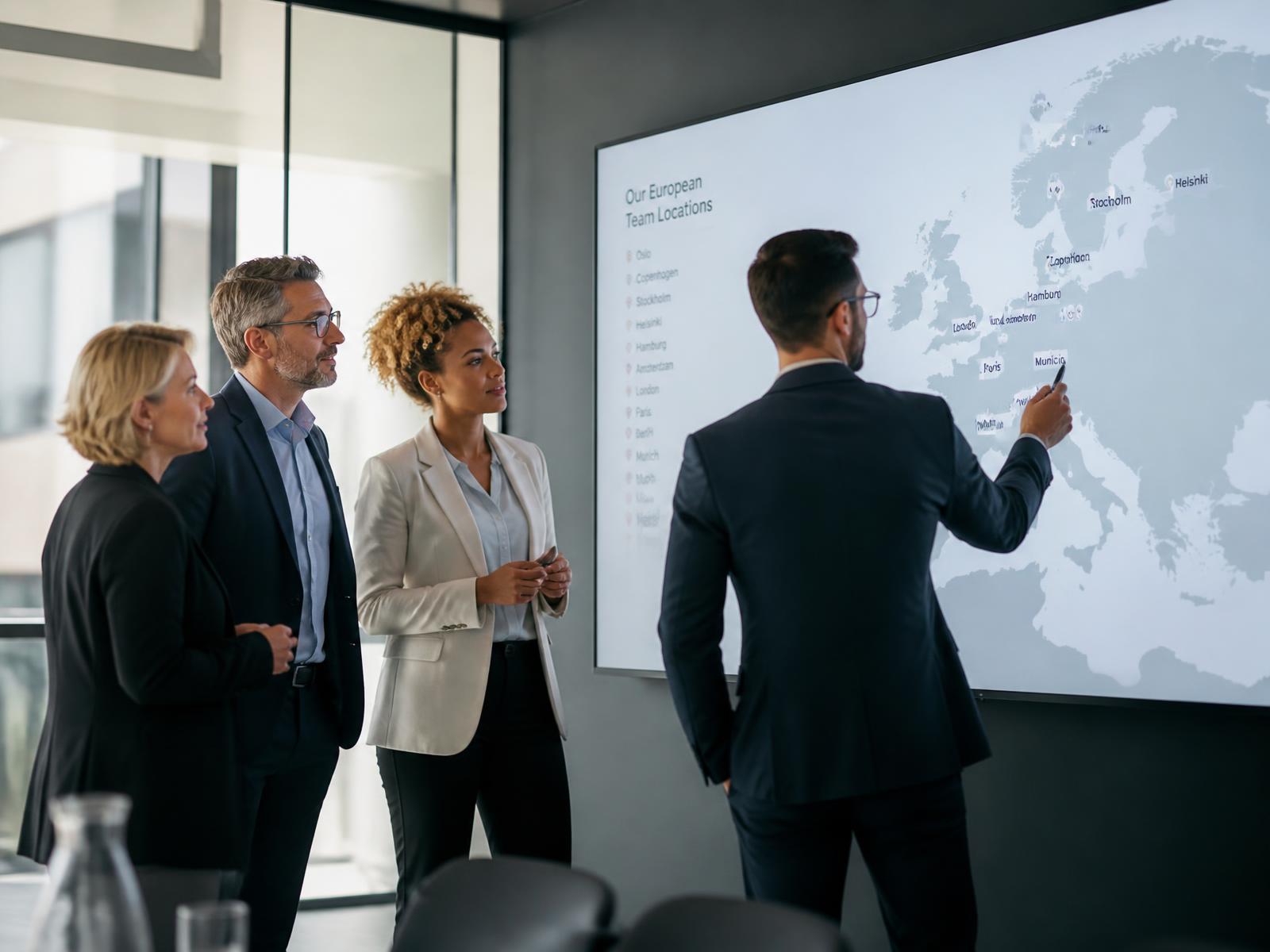
“Every country runs the same company differently — and by the time headquarters sees the data, it is already three weeks old.”
International companies rarely fail on strategy. They fail on the operational layer underneath it: one country tracks working time in a spreadsheet, another in a local HR tool, a third through the payroll provider's portal.
Each is defensible on its own. Together they make a single workforce impossible to govern — approvals depend on who happens to be in the office, and every group-level question turns into a data collection exercise.
What these organisations need is not another country system. It is one operating model that every country executes locally.
Where multi-country operations break down
The cost is rarely a single failure. It is the accumulated overhead of running one workforce through many disconnected systems.
Central governance, local execution
Sommet360 keeps the group operating model intact while letting each country work the way it must.
Employees, EOR workers and contractors sit in the same structure, so group reporting no longer depends on which country a person belongs to.
Define the standard centrally, adjust entitlements and calendars per country, and keep both visible in one place.
Approvals follow the structure, not individual mailboxes — delegation, escalation and hierarchy are configured once.
Every request, acknowledgement and signature is recorded at the moment it occurs, so audit preparation is retrieval instead of reconstruction.

The same operating model in Warsaw, Lisbon and Amsterdam — reported as one workforce.
Group visibility stops being a reporting project and becomes a property of how the organisation works day to day.
How the platform is assembled for a multi-entity group
Capabilities plug into one shared workforce structure — entities, countries, teams and approval hierarchies.
Entities, countries, cost centres, teams and approval hierarchies defined once and reused by every capability.
Opening operations in a new country
The same sequence every time — regardless of which country is next.
Why this holds up as the organisation grows
Adding the eleventh country should cost less operational effort than the third — not more.
A new entity starts from the group model instead of a blank system, so expansion no longer resets the operating standard.
Because every capability reads the same workforce structure, group reporting is a query rather than a consolidation exercise.
Country-level calendars, entitlements and languages remain local while governance, approvals and evidence stay consistent.
Related operating models
Most international groups run more than one workforce model at the same time.
See the group operating model in practice
A walkthrough using your entity structure, countries and approval hierarchy.
Book a Demo